
Originally published on WTHR.com, March 3rd, 2016
Two years after winning the Michigan-based ArtPrize, Indianapolis artist Anila Quayyum Agha’s award-winning work “Intersections” is coming to the Circle City. Her message of inclusion is a well-timed breath of enlightenment during a divisive election year. The exhibit, which is a part of the “200 Years of Indiana Art: A Cultural Legacy” program, opens March 19, 2016, at the Indiana State Museum.
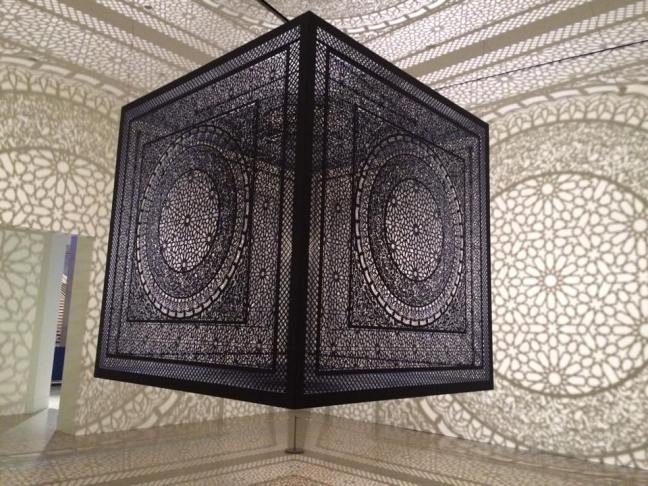
The sculpture, which casts intricate shadows through a three-dimensional suspended, latticed cube, has gone global, with exhibitions in Spain, Turkey, South Korea, Texas and Massachusetts. A prototype is suspended from Agha’s ceiling in her near east side Indianapolis home. The smaller version, which is a few square feet, captures the spell-binding power of the larger work, and Agha says that’s exactly the point. She likens the experience to watching the sunset on a beach. Not only does it create an opportunity for contemplation, but it’s also a great equalizer. “You’re just a speck on the sand,” she said.
“Intersections” is a 6.5-foot square cube built from laser-cut wood and contains a single light bulb. Its shadows extend over 30 feet from the sculpture. Many visitors stop to take photos or selfies in the exhibition hall, with the shadows of latticework cast on their faces. Whether they realize it or not, they’re internalizing Agha’s message of inclusion “because everybody becomes a shadow on the wall and on other people as they’re walking past. You’re kind of casting a shadow and they’re casting a shadow…and all the shadows are being cast on the wall. And you realize everybody’s anonymous in there.”
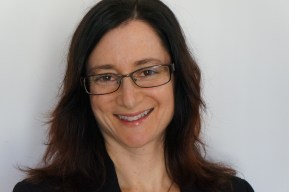
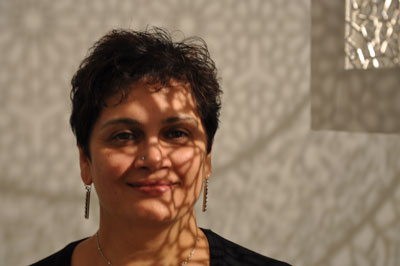 Agha (shown left), who teaches at the Herron School of Art, came to Indianapolis by way of Texas, where she completed her MFA in Fiber Arts from the University of North Texas in 2004, and before that, her native Pakistan.
“My influences started from the time I’d been raised in Pakistan because I was very familiar with the patterns,” she said. Agha mentions textile prints and traditional batiks as early influences, but a 2011 visit to the Alhambra Palace in Spain made a clear impact. “The only way I can explain it is it felt like I’d come home. It felt very familiar,” she said.
The intricate latticework of “Intersections” invokes the detailed crenelations and patterned cut-outs of Alhambra, and the shadows thrown at the walls by the light inside the box elicit a breathtaking sense of awe.
That feeling of stepping into a sacred place is deliberate. Agha explained that Pakistan lacks funding for the arts and typically puts money towards beautifying mosques, not building museums. But she says not everyone is welcome to inhabit that contemplative space.
“The only place in Pakistan that looks like a museum is a mosque, and women are excluded from that,” she said.
At Alhambra, which reminded Agha of the mosques of the subcontinent with its carving and tile work, “my immediate reaction was I’m walking through this space and nobody’s chasing me out. If I go to Pakistan and I try to go to a mosque, people tell me, ‘go home. You shouldn’t pray here.’ It was like that negative versus the positive and I immediately felt like I wanted to create something that talked about this feeling of exclusion, and turn it into something positive.”
As an immigrant living in the United States for the past 16 years, Agha says the sense of exclusion is always present, although it’s something she can turn to her advantage as an artist.
The observant outsider
“I am always the outsider wherever I go now,” she said. Even after 16 years, “I still am not 100 percent from here. Also, I think the people here will never consider me as being from here, especially since I speak with an accent. But now when I go back to Pakistan, people over there think that I’m a foreigner. I’m an outsider from both. I find that position a very interesting position because it always teaches you about what it feels to be an outsider, and to be excluded – always looking in. But it’s always a really good position to hold, because what it allows you to do is to observe.”
She compares the situation to writers making observations. “You just watch people over time and you insert that character you’re finding interesting into your work. It’s the same thing. You observe, you look at the common versus the contrast. Travel really helps to do that a lot.”
Becoming aware of cultural differences, and working to find common ground while respecting them, is a theme present in Agha’s art and in her teaching. She recalls taking her students to Spain a few years ago for a study abroad trip and cautioning them that an unfamiliar culture could bring challenges. “Here you feel very comfortable wherever you go, you’re confident. But when you’re somewhere else and there’s a different language being spoken. It’s also the body language and the way people talk and walk.’”
Her students found the experience of public courtyards eye-opening. “It’s a very social aspect of life that we don’t see here. For students who go there to witness that and participate in that, it was a mind-opening exercise.”

Agha hopes the City of Indianapolis will invest in more public spaces and rehabilitation of struggling neighborhoods like the near east side. “There’s no real place for people to just go out and walk and be social,” she said, although she does mention Mass. Ave.’s transition. The Cultural Trail is another effort by the city to create that shared space.
“Intersections” is very much about creating shared space, too.
“I wanted to make the space safe for everybody so we could talk about things or we may not. We become contemplative. You’re so tiny in comparison to the world around you,” Agha said.
Creating dialogue
With the upcoming presidential election looming, Agha is concerned about the increasingly fractious nature of the debate.
“There are so many things in this country that are so fractured, and in my opinion, we could surpass or at least bring people together to create a dialogue that would be good for us. We constantly divide and rule. We offend so we can get some people to leave the table. As an educator, that is a very important thing for me to have dialogue,” she said. While a lot of progress has been made, Agha says there’s still work to be done.
Agha is on sabbatical this year, and her schedule is packed with exhibitions and travel. She was just about to set off for a trip to the American University of Dubai, where she’ll be giving an artist lecture. I asked her how winning the $300,000 ArtPrize changed her life.
“It’s not like I wasn’t busy previous to the win, but it just went on fast forward after that,” Agha said, explaining that she was inundated with interview requests over the course of a few months following the announcement in 2014. Since then, it’s been something of a happy whirlwind, with a lot more shows. She’s also sold a few of her pieces.
“The work is not a problem,” she said. “I’ve been very lucky and grateful. It’s wonderful! I’m enjoying my 15 minutes of fame!”
 Sara K. Galer